
Cowichan Knitting
For Truth and Reconciliation Day, we wanted to focus on Indigenous fibre arts. Often it is beading and ribbon skirts that come to mind when thinking of Indigenous arts, but we would like to bring a focus to Cowichan Sweaters, which represent both the oppression of the Indigenous peoples and their resilience and adaptation to keep their culture alive.
Now, let us be clear that the author of this article is not Indigenous, but has taken great care to source information from Cowichan Knitters themselves. It is important to represent the voice of the communities we write about, especially with the complicated history of fibre arts in Canada. Where a primary source wasn’t available, establishments that work with First Nation communities were used as sources. If any information is incorrect or misinformed, please let us know, and we will update and correct this article.

Hul'qumi'num Place, The Traditional Territory of the Cowichan Peoples
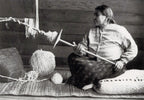
Coast Salish Peoples have a long history of fibre arts, starting hundreds of years before any settlers arrived. Weaving was important as an art form, a display of wealth, and a religious and cultural symbol. Settlers came to Hul’qumi’num Place (the traditional name of the territory of the Cowichan People) in the 1850’s. Weaving and spinning was done with mountain goat wool, Salish Wooly dog fur, and plant fibres. Spinning was done on a spindle and whorl.


Woman Spinning yarn at the Coast Salish village of Musqueam, 1915.
Sheep were introduced in the 1850s, and settlers systematically cross-breed the Salish Wooly dog out to ensure that Indigenous Peoples would be reliant on new, western supplies. Although knitting could have been introduced earlier then the 1850s, the organized instruction of knitting began around 1864, when the Sisters of St. Ann relocated from Victoria to the Cowichan Valley. Originally only wool preparation, knitting mittens, and knitting socks were taught. As more settlers became neighbours, more styles of knitting were introduced. Cowichan women, already skilled in traditional fibre arts, quickly adapted to these new garments and styles. In the early years, they most commonly created knee-length undergarments and sweaters.
The earliest form of a Cowichan Sweater was knit in the round, using double pointed needles. Although Europeans did use multiple needles for items like hats, mittens, and socks, the construction of the Cowichan Sweater was quite different from the western style of seaming sweaters together. British and Scottish settlers had a large influence on the style of the Cowichan Sweater. Pattern work with texture and colour evolved from the Gansey and Fair Isle sweaters that accompanied settlers to the area. It is of popular opinion that the influence of colourwork in Cowichan knitting came from one Scottish woman, Jerimina Colvin, who came from the Shetland Islands in 1885. She raised her own sheep, dyed her own wool, and is thought to have taught knitting to the local population of both settlers and Indigenous peoples.

Cowichan Sweater (Unfinished). Eca Williams, 1985, Coast Salish: Quwutsun’
Another contribution to the popularity of the Cowichan Sweater was the introduction of the Indian Act in 1876. The purpose was oppression and assimilation of the First Nations Peoples across Canada by colonizers. In 1884, the Potlatch Law was enacted. This was the start of the banning of important ceremonies for coastal First Nations peoples. Blankets, an important part of the ceremony, as well as other ceremonial items were banned. Traditional dress of any kind was illegal. Art and expressions of Indigenous religion, culture, and pride were systematically attacked and devalued in the name of assimilation.
In an era where all First Nation Peoples were not allowed to follow their own customs and traditions, the Government of Canada did allow small handicrafts for income. Basket weaving was common and popular with tourists. In the Cowichan Valley, knitting was a particularly accessible form of income. Extremely undervalued and underpaid, it still allowed the traditional arts of the Cowichan Peoples to survive. They harvested plants, such as the Oregon Grape and Balsam, to dye wool. The entire family helped prepare the wool for spinning and knitting.
Designs were taken from traditional Salish basketry and weaving motifs, as well as from other aesthetically pleasing items. Knitting these sweaters was not a lucrative business, and often Indigenous craftsmen were not allowed to sell directly to the public. They would be forced to buy wool from the store selling their work, allowing storeowners economic power over the Indigenous peoples. They would sell wool extremely expensively to the knitter (few Indigenous Peoples owned sheep) and buy back the finished sweater cheaply.
Retail stores in Duncan, Victoria and Vancouver sold Cowichan sweaters beginning in the 1920s. The sweaters were worn by everyone - including Queen Elizabeth II and Bing Crosby - and the demand for the garments quickly outpaced Indigenous Knitters. An influx of inauthentic sweaters began to flood the market in the 1950s. Commercial enterprises such as White Buffalo and Mary Marxim quickly appropriated the trend, offering machine spun roving to imitate the unique yarn fibre, and pattern booklets full of designs. On the fast-fashion side, Cowichan Sweaters began being mass produced via machine with thinner yarn. A boom of Japanese tourists in the 1970s brought the Cowichan Sweater back into style, and the copy-cats became more frequent. At one point, it is estimated that twice the amount of inauthentic sweaters were sold compared to authentic garments from Indigenous creators. In 1980, the Cowichan Band Council won an out of court battle to prevent the Cowichan name from being used by commercial wool and enterprises. However, even in recent years the Cowichan sweater has been appropriated.
In 2009, Hudson’s Bay Company released their 2010 Olympics Collection in preparation for the Vancouver Olympic Games. One of the products was advertised as a Cowichan Sweater - except it was not Cowichan designed, Cowichan knit, or Cowichan created in any way. It featured traditional designs such as geometric shapes, symmetric elk heads, and maple leaves. The backlash was immediate. The Cowichan First Nations and HBC eventually settled on a deal, but this incident showcases the constant struggles that Indigenous knitters still face today.


The Hudson Bay 2010 Knit Sweater.
The actual structure of an authentic Cowichan Sweater is distinctive. Designs inspired by nature, animals, totem poles, and geometric patterns are common. The way the wool is spun is unique as well. Instead of ‘tossing’ the spindle (free rotation in the air), the spindle is rolled along the thigh. Originally, spinning wheels were created from sewing machines, or they were completely homemade. The spinner would sit facing the orifice (opening) instead of to the side of the flyer. This design has been mass-produced today, often called a Bulky or Indian Head Wheel.


Two Styles of an Indian Head Wheel. One converted from a Sewing Machine, the other homemade.
The collars of the sweater were knitted in three sections - the back of the neck being put on hold earlier in the knitting process. This makes the iconic Shawl Collar design. The knitter will use a garter stitch, basket stitch or ribbing with one or two colours. Sleeves are also unique. Instead of being knit separately and seamed onto the garment, the stitches were put on hold and then knit in the round, directly on the sweater. Although a common technique now, it was very innovative in the early 20th century. The coloured wool of a Cowichan Sweater is dyed with natural dyes, or knitted in natural colours.
 Cowichan Cardigan "C6-18", Knit by Joanne Hopkins
The Cowichan sweater has many fibres of complex history spun into its wool. It is a symbol of Indigenous resilience, art, culture, and history. It is also a representation of Canadian oppression, appropriation, and reconciliation. Cowichan knitters are still active, and selling their wares. Today, we can recognize and accept both aspects of the representation of the garment and its history.
The Cowichan Sweater, both in the past and in its modern interpretation, is a beautiful work of art. From the spinning to the dyeing to the knitting, its designs, shape, and technique is intricate, complex, and proudly unique to the Indigenous Peoples who create it.
Written by Annelle B., September 2025.
Sources
“The Coast Salish Knitters and the Cowichan Sweater: An Event of National Historic Significance”. Stopp, Marianne P. Material Culture Review 76 January 2012,. https://journals.lib.unb.ca/index.php/MCR/article/view/21406.
“Authenticity.” Knit, 18 July 2024, knitwithpurpose.com/authenticity/.
“After Years of Exploitation, the Iconic Cowichan Sweater Is Being Protected with a New Fair-Trade Program.” Indiginews, Graeme, Mike., 24 Oct. 2023, indiginews.com/vancouver-island/after-years-of-exploitation-the-iconic-cowichan-sweater-is-being-protected-with-a-new-fair-trade-program/.
“History.” Knit, 4 Sept. 2024, knitwithpurpose.com/history/.
“Knit.” Victoria Native Friendship Centre, 27 May 2024, vnfc.ca/knit/.
“Cowichan Indian Knitting.” University of British Columbia, Museum of Anthropology, Meikle, Margaret., 1987. https://open.library.ubc.ca/soa/cIRcle/collections/ubccommunityandpartnerspublicati/52387/items/1.0103648.
“Terminology.” Indigenous Foundations, University of British Columbia, indigenousfoundations.arts.ubc.ca/terminology/.
“Traditional Territory.” Cowichan Tribes, cowichantribes.com/about-cowichan-tribes/land-base/traditional-territory
Another article I thought you might enjoy. Hope you are having a fabulous time in Africa. Ann


Subscribe to our email newsletter today. We let you know about the hottest patterns, the newest sales, and so much more!