
Socks and Sandals Have Always Been A Fashion Staple
People of all cultures and time periods have always had a craving for handknit socks.
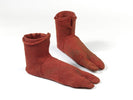
People of all cultures and time periods have always had a craving for handknit socks. Archeological artifacts from Egypt (pictured below) shows socks dating as far back as the third to fifth century AD!

Historically, socks were knit flat and sewn together. Our ancient ancestors quickly figured out a faster way to create these woolly wonders and started knitting ‘in the round’ on five to six smaller sticks, with both ends tapered to allow easier passing of rows. Knitting on double pointed needles (DPN) is still a commonly used technique today. This technological advancement also allowed for easier colourwork, leading to beautiful designs that mimicked other popular art motifs of the time, such as blue and white pottery.
Socks were also a historical indication of class and status. Hand knit stockings made from luxurious materials such as silk were a quiet boast of luxury, hidden beneath other layers of extravagant materials. Elizabeth I was the first monarch documented to wear silk stockings, and the industry began to pick up on this luxury market. Soon stockings were embroidered with royal initials and family crests. It’s in this era that we see socks turn to solid colours, such as white, black, and even red!
Silk was the hottest trend in the Middle Ages, and its popularity didn’t stop at aristocratic legs. However, wool stockings were just as beloved, especially with technological advancements that allowed it to be spun as fine as silk. In some markets it was more expensive than it’s imported counterpart, mimicking the sheen and softness but still providing warmth. In eras before centralized heating it’s no wonder that socks and stockings were so valued by every person, regardless of status.
As the industrial revolution raged on, machine knitting became the main mode of producing socks and stockings. People who relied on knitting and selling socks to supplement their finances became concerned about the loss of income. Queen Victoria, a proud knitter herself, revitalized the fibre arts movement in the United Kingdom. She even wore stockings that she knit herself!
As hemlines went up, the length of stockings went down, and eventually became the shorter length socks that are a staple garment today. Handknit socks have enjoyed a second golden era (although, in our opinion, they have had a continuous golden era since their inception). There are fibres of all kinds, the most common being alpaca, wool, nylon blends, bamboo, cotton, cashmere and silk. No longer limited to the natural whites, blacks and red of the past, knitters can enjoy a wide colour palette to create the perfect gradient, colourwork, or stripe combinations.


Subscribe to our email newsletter today. We let you know about the hottest patterns, the newest sales, and so much more!